Thursday, June 16, 2011

Grand Lake Watershed Coalition

A new group called, Grand Lake o' the Cherokee Watershed Coalition, has started meeting to begin communicating, sharing and planning for the future. Representatives from Elk River, Shoal Creek (upper and lower), Spring River (Kansas and Missouri) and the Neosho River Basin Watersheds met with Grand Lake Watershed Alliance representatives in Joplin, in April. Possible goals and objectives of the group will be discussed at a meeting later this month. It is inspirational to be meeting with other watershed enthusiasts.

Spring River Watershed Partnership -update-

The Spring River Watershed Alliance met again this week to identify, and then prioritize the Best Management Practices (BMP) to be included in he group’s 319 Grant Application Plan. Representatives contributing to the process included, Jasper County Health Department, Harry S. Truman Coordinating Council, City of Carthage, Carthage Water and Electric Plant, Jasper County, University of Missouri Extension, Missouri Department of Conservation, Natural Resources and Conservation Service, Missouri Southern State University, and the Southwest Ozarks Stream Teams (SWOST).

Some items discussed included: Riparian Corridor improvement, encouraging Carthage residents to hook up to new sewer lines, complete a wetland study for a couple of Carthage’s storm water run off conduits, identify and get established commercial rain gardens, complete testing to identity animal/human sources of bacterial contamination, and work with SWOST to host a Carthage Area Water Festival and start new Carthage Stream Teams.

Tuesday, June 14, 2011

E. coli Test Results for Spring River, 2011

The Jasper County Health Department began testing for E. coli bacteria in Spring River in May 2007. They selected seven sites for weekly testing, including: Spring River at County Road 3 (referenced as SR1), Spring River at County Road 85 (SR2), Spring River at Kellogg Lake-Carthage (SR3), Spring River at Francis Street-Carthage (SR4), Spring River at Quaker Mill on County Lane 216 (SR5), and Spring River at Kafir and State Line (SR7). The following are test results for 2011.

The test results are shown as # of colonies of E. coli bacteria per 100 milliliters of river water. The data in Bold indicates that the # of colonies are in excess of the maximum recommended by the US EPA for bodily contact, which is 235 colonies of E. coli per 100 milliliter of water sampled. The Missouri Department of Natural Resources (MDNR) recommends a maximum of 126 E. coli colonies per 100 ml. as the limit for "recreational" swimming and whole body contact, annually between April 1 and October 31. The data is arranged by sampling site, with the latest data 'on top'.

Spring River at County Road 3 (SR1)
10/10/2011, 387.3
10/05/2011, 90.6
09/28/2011, 95.9
09/21/2011, 114.5
09/14/2011, 52.1
09/07/2011, 25.9
08/31/2011, 86
08/24/2011, 68.3
08/17/2011, 104.6
08/09/2011, 240
08/04/2011, 86
07/27/2001, 67.7
07/19/2011, 44.8
07/14/2011, 85.7
07/06/2011, 26.9
06/29/2011, 31.8
06/22/2011, 84.2
06/15/2011, 206.4
06/09/2011, 74.4
05/25/2011, 1,986.3

Spring River at County Road 85 (SR2)
10/10/2011, 517.2
10/05/2011, 137.6
09/28/2011, 218.2
09/21/2011, 116.9
09/14/2011, 31.3
09/07/2011, 47.9
08/31/2011, 68.3
08/24/2011, 71.2
08/17/2011, 65.7
08/09/2011, 151
08/04/2011, 150
07/27/2001, 37.6
07/19/2011, 62
07/14/2011, 66.3
07/06/2011, 29.8
06/29/2011, 71.2
06/22/2011, 56.5
06/15/2011, 108.6
06/09/2011, 59.8
05/25/2011, 2,149.6

Spring River at Kellogg Lake-Carthage (SR3)
10/10/2011, 67.7
10/05/2011, 52.9
09/28/2011, 116.9
09/21/2011, 2419.6
09/14/2011, 39.7
09/07/2011, 17.3
08/31/2011, 63.8
08/24/2011, 28.8
08/17/2011, 113.7
08/09/2011, 227.9
08/04/2011, 10.1
07/27/2001, 40.3
07/19/2011, 42.2
07/14/2011, 66.3
07/06/2011, 22.8
06/29/2011, 44.8
06/22/2011, 56.1
06/15/2011, 67
06/09/2011, 60.2
05/25/2011, 2,419.6

Spring River at Francis Street-Carthage (SR4)
10/10/2011, 55.6
10/05/2011, 60.5
09/28/2011, 83.6
09/21/2011, 1732.9
09/14/2011, 65.7
09/07/2011, 27.8
08/31/2011, 103.9
08/24/2011, 178.5
08/17/2011, 95.9
08/09/2011, 163.1
08/04/2011, 1986.3
07/27/2001, 45.9
07/19/2011, 69.7
07/14/2011, 39.3
07/06/2011, 31.3
06/29/2011, 41.4
06/22/2011, 56.5
06/15/2011, 39.7
06/09/2011, 67.6
05/25/2011, 1,732.9

Spring River at Quaker Mill on County Lane 216 (SR5)
10/10/2011, 124.6
10/05/2011, 86
09/28/2011, 66.3
09/21/2011, 88.2
09/14/2011, 36.5
09/07/2011, 30.5
08/31/2011, 46.5
08/24/2011, 35
08/17/2011, 53.6
08/09/2011, 148.3
08/04/2011, 88.9
07/27/2001, 83.6
07/19/2011, 70.5
07/14/2011, 71.7
07/06/2011, 98.8
06/29/2011, 96
06/22/2011, 107.1
06/15/2011, 90.5
06/09/2011, 86
05/25/2011, 2,419.6

Spring River at County Road 270 (SR6)
10/10/2011, 124.6
10/05/2011, 121.1
09/28/2011, 65
09/21/2011, 95.9
09/14/2011, 61.3
09/07/2011, 43.5
08/31/2011, 71.2
08/24/2011, 35.4
08/17/2011, 235.9
08/09/2011, 70.8
08/04/2011, 113.7
07/27/2001, 218.7
07/19/2011, 59.4
07/14/2011, 50.4
07/06/2011, 49.6
06/29/2011, 86
06/22/2011, 1413.6
06/15/2011, 58.3
06/09/2011, 101.7
05/25/2011, 2,419.6


Spring River at Kafir and State Line (SR7)
10/10/2011, 54.6
10/05/2011, 46.4
09/28/2011, 78.9
09/21/2011, 148.3
09/14/2011, 107.0
09/07/2011, 290.9
08/31/2011, 142.1
08/24/2011, 88.4
08/17/2011, 36.9
08/09/2011, 65.1
08/04/2011, 69.5
07/27/2001, 129.5
07/19/2011, 60.2
07/14/2011, 104.6
07/06/2011, 62.4
06/29/2011, 107.6
06/22/2011, 1299.7
06/15/2011, 71.2
06/09/2011, 93.3
05/25/2011, 1,986.3

For further information, contact:
Jasper County Health Department
105 Lincoln
Carthage, MO 64836
417/358-3111
417/358-0494 (fax)

Sunday, April 24, 2011

Spring River Watershed Management Plan for HUC # :11070207140002

The purpose of the Spring River Watershed Management Plan is to provide an initial assessment and a general strategic plan for the Spring River Watershed, and to focus on a 14-Digit HUC Code portion located in Central Jasper County near Carthage. The whole length of Spring River is listed for elevated bacteria levels. The Total Maximum Daily Load (TMDL) that will be written by the Missouri Department of Natural Resources (scheduled to be developed in 2013) will incorporate the entire 8-Digit HUC Code for Spring River, however, to begin with and be proactive, the Spring River Watershed Partnership will focus on the smaller 14-Digit HUC Code.


--------------------------------------------------------------------------------

Spring River Watershed Partnership -Update-

The Spring River Watershed Partnership met again on April 19, 2011, to review the organizations’ application for a Section 319 Nonpoint Source Implementation Program, through the Missouri Department of Natural Resources. The group discussed a multitude of watershed ‘best practices’ that the grant will help implement. They will be working with Carthage (MO) citizens and area landowners to identify projects that they are interested in, and then see if they can get them funded through the grant. In addition, the group will focus on contacting stakeholders within the Spring River Watershed or those interested in helping, like Stream Teams, Boy Scouts and other organizations.

Links for more information about Section 319 Nonpoint Source Program in Missouri:
http://www.dnr.mo.gov/env/wpp/nps/index.html
http://www.dnr.mo.gov/env/wpp/nps/319overview.htm http://www.dnr.mo.gov/env/wpp/nps/mgmtplan/index.html

Sunday, December 19, 2010

MDNR's Spring River Initiative

The Joplin Globe, in it's headline "DNR Wraps Up Spring River Permit Check"(12/18/2010)reported that 13 out of 66 permits were initially found to be "out of compliance". The article reports that all but three of the discharge permit holders have been brought back into compliance. One, Carthage Crushed Limestone, has been referred for more 'aggressive enforcement'.

Here are links to the Missouri Department of Natural Resources, Spring River Initiative project.

News Release 506 - Spring River sampling and inspection initiative continues water quality emphasis, August 27, 2010. The Missouri Department of Natural Resources’ Spring River Initiative, which began in June and will run through October, includes inspections and water quality sampling at 68 permitted facilities in Barton, Jasper and Lawrence counties. “The goal of this sampling and inspection initiative is to gather data to determine if discharges from permitted facilities are meeting water quality standards and are protective of the Spring River,” said Mark N. Templeton, director of the Department of Natural Resources. “In cases where facilities are not meeting the standard, this data helps us ensure the facility takes the proper corrective measures.” The inspection sites include industrial storm water facilities, permitted concentrated animal feeding operations, or CAFOs, land disturbance sites and domestic waste water facilities, some of which may discharge directly to the Spring River or the North Fork of the Spring River.

Total Maximum Daily Load Information Sheet - Spring River Water Body Identification No. 3160

Missouri Department of Natural Resources -Spring River - WBID 3160, Bacterial Data, 2005-07

Monday, October 11, 2010

12th National Conference on Tar Creek, Sept 22-23, 2010

The 12th Annual Tar Creek Conference was held September 22-23, 2010 at the Miami (OK) Civic Center. This year's theme was "Moving on...Ton by ton." The reference is to the removal, relocation, repository, encapsulation and management(reuse) of the contaminated chat (mine tailings) prevalent in the area, one truck load at a time. The conference was coordinated by the Local Environmental Action Demanded Agency(LEAD, Inc).

This area is predominantly held in tribal land by the Quapaw, Seneca-Cayuga, Ottawa, Peoria, Eastern Shawnee, Modoc, Wyandotte and Shawnee Tribes. Of particular relevance to the Spring River (and the greater Grand Lake O' The Cherokee) Watershed were presentations by EPA Region 6 ad 7, Mine Water Remediation, Measuring the Recovery of a Superfund Stream, Watershed Mercury Study, Spring River WRAPS, Effects of Nutrient Loading on Aquatic Life and Nutrient and Bacteria Source management.

Monday, September 20, 2010

"Spring River Initiative" and DNR Violations

The Joplin Globe, Monday, Sept.20, 2010, reported on Missouri DNR's recent "Spring River Initiative", inspecting businesses and municipalities along Spring River for permit violations. According to DNR, 68 business, large agricultural operations and municipalities in Jasper, Lawrence and Barton counties have permits to discharge into the river or its tributaries. Samples of treated waste water also are being taken from some of those sites. Seven of 31 businesses and municipalities with permits to discharge into Spring River in Southwest Missouri did not meet state requirements during a recent round of inspections.

Violators include:
Blue Top Motel and Cafe, Lamar (Bypassing a lagoon, for vegetation growing on berms around the lagoon, and failure to report discharges since June 2001.)
Feltenberger Enterprises, Lamar (General Failure to operate and maintain the site in accordance with DNR permit.)
Schrader's Salvage, Carthage (Not having an annual report, because contaminants were exposed to storm water, and because outfalls were not marked.)
D&D Dirt, LLC, Webb City (Not having Best management practices in place and because outfalls were not marked.)
Carthage Specialty Pallet Co., Carthage (Did not have storm water pollution prevention plans in place.)
D&D Sexton, Carthage (Did not have storm water pollution prevention plans in place.)
The Lamar City Airport, Lamar (Did not have storm water pollution prevention plans in place and also because it did not have inspection logs.)

Friday, September 10, 2010

Body Contact is NOT Recommeded, September 9, 2010

The Jasper County Health Department has posted the results of their 09/09/2010 water quality testing at seven locations on Spring River. Specifically, this is the number of Escherichia coli colonies per 100 milliliters of river water. The Environmental Protection Agency (EPA) has determined that swimming and body contact is NOT recommended when the sample exceeds 235 E. coli colonies per 100 ml. The Missouri Department of Natural Resources (MDNR) recommends a maximum of 126 E. coli colonies per 100 ml as the limit for "recreational" swimming and whole body contact, annually between April 1 and October 31.

The 09/09/2010 test results (E. coli colonies per 100 ml) and locations are listed below:

Swimming and body contact is NOT recommended at these sites.
2,419.6, Spring River at County Road 3
1,986.3, Spring River at County Road 85
1,203.3, Spring River at Kellogg Lake
980.4, Spring River at Francis Street
1,119.9, Spring River at Quaker Mill, County Lane 216
770.1, Spring River at County Road 270
1,413.6, Spring River at Kafir and State Line

For further information, contact:
Jasper County Health Department
105 Lincoln
Carthage, MO 64836
417/358-3111
417/358-0494 (fax)
moehra@lpha.dhss.mo.gov (e-mail)
877-879-9131 (toll free)
8:30 - 4:30 (hours)

Thursday, August 12, 2010

Spring River Watershed Partnership Mtg #6

The Spring River Watershed Partnership Committee met today. Strategic tasks included: (1) accepting the Spring River Watershed Management Plan for HUC #11070207140002, (2) discussing educational and planning grants that compliment the Watershed management Plan, (3) learning about initiatives in the Spring River Watershed Restoration and Protection Strategy (WRAPS)-Cherokee County, KS and the Grand Lake Watershed Plan, (4) discussing strategies to promote and develop Missouri Stream Teams along the Spring River Watershed, including adjacent landowners, educational and citizen groups, (5) developing a council of regional watershed groups, including: Grand Lake O' The Cherokee Alliance, Spring River Watershed Restoration and Protection Strategy (WRAPS), Upper Shoal Creek and Lower Shoal Creek Watershed Partnerships, Elk River Watershed Improvement Association (ERWIA) and the Spring River Watershed Alliance, and (6) a WRAPS project (Cherokee Co., KS) to keep prescription drugs out of the water supply. (7) It was also reported that the Jasper County Health Department received grant funding to expand testing for E.coli, at 24 additional sites in Jasper County streams and creeks. (8) The Committee discussed creation a Citizen's Advisory Committee for the purpose of continued input, planning and execution of the Spring River Watershed Partnership Plan. (9) The Committee discussed the possibility of collecting water quality data from regional Stream Teams, currently testing for pH, nitrates, dissolved O2, turbidity and conductivity. The Jasper County Health Department is only testing for E.coli. (10) Committee Members indicated an interest in floating the designated Spring River Watershed (County Rd 100 to County Rd 200).

Wednesday, July 21, 2010

Body Contact is NOT Recommended 07/13/2010

The Jasper County Health Department has posted the results of their 07/13/2010 water quality testing at seven locations on Spring River. Specifically, this is the number of Escherichia coli colonies per 100 milliliters of river water. The Environmental Protection Agency (EPA) has determined that swimming and body contact is NOT recommended when the sample exceeds 235 E. coli colonies per 100 ml. The Missouri Department of Natural Resources (MDNR) recommends a maximum of 126 E. coli colonies per 100 ml as the limit for "recreational" swimming and whole body contact, annually between April 1 and October 31.

The 07/13/2010 test results (E. coli colonies per 100 ml) and locations are listed below:

Swimming and body contact is NOT recommended at these sites.
1299, Spring River at County Road 3
866.4, Spring River at County Road 85
579.4, Spring River at Kellogg Lake
488, Spring River at Francis Street
686, Spring River at Quaker Mill, County Lane 216
344.8, Spring River at County Road 270
727, Spring River at Kafir and State Line

For further information, contact:
Jasper County Health Department
105 Lincoln
Carthage, MO 64836
417/358-3111
417/358-0494 (fax)
877-879-9131 (toll free)
8:30 - 4:30 (hours)

Sunday, July 11, 2010

SWOST Article in MO. Stream Team Newsletter "Channels"

Our Southwest Ozarks Stream Team Association (SWOST)is highlighted in an article in the new (July-August 2010) Missouri Stream Team publication, Channels (see page 8). Congratulations to SWOST and all of the Southwest Missouri Stream Teams that are participating in their regional initiatives.

Friday, May 28, 2010

Risky Recreation

The Joplin Globe, Risky Recreation- unsafe Levels of E. coli at area sites, Friday, May 28, 2010, reviews and compares this weeks water quality tests done in both Newton and Jasper County. The article states that 16 of 22 Newton Country (test) sites and 6 of 21 Jasper County sites had E.coli levels above the Federal limit of 235 colonies of E.coli per 100 milliliters of river water. Bob Kulp, Administrator of the Newton County Health Department and Tony Moehr, Director of the Jasper County Health Department, were both interviewed and quoted in the article.

Wednesday, May 26, 2010

2010 E. coli test Results Shoal Creek Watershed

The Newton County (Missouri) Health Department has resumed water quality testing in the Shoal Creek Watershed. They are sampling every 2 weeks. They have identified twenty-two different test sites on Baynham Branch, Beef Branch, Capps Creek, Carver Branch, Cedar Branch, Clear Creek, Hickory Creek, Spring Creek, Silver Creek, Thurman Branch, and Shoal Creek. Here is the link to their E. coli test data. Here is the link to a map of their test sites.

Site #/Stream-Creek Name (numerical)
#6, Shoal Creek at Tipton Ford CA
7, Cedar Branch on Old Scenic Road
8, Baynham Branch on Lime Kiln Rd.
9, Carver Branch on Lime Kiln Rd.
20, Shoal Creek at Old HWY E, Granby
21, Shoal Creek at Cherry Comers CA
23, Shoal Creek at HWY W, Ritchey
24, Shoal Creek at Smack Out Rd.
26, Capps Creek at Capps Creek CA
51, Hickory Creek on BUS HWY 60
52, Shoal Creek at Lime Kiln CA
68, Beef Branch on Cedar Rd.
88, Clear Creek at Walleye Rd.
93, Capps Creek below Jolly Mill dam
94, Shoal Creek in Wildcat Park
114, Silver Creek on 44th St.
115, Silver Creek in Wildcat Park
116, Thurman Branch on Gateway Dr.
117, Thurman Branch on Shoal Creek Dr.
118, Beef Branch on Cedar Rd.
119, Spring Creek in Reddings Mill
120, Shoal Creek upstream from Falls

Stream-Creek Name /Site # (alphabetical)
Baynham Branch on Lime Kiln Rd., #8
Beef Branch on Cedar Rd., #68
Beef Branch on Cedar Rd.m #118
Capps Creek at Capps Creek CA, #26
Capps Creek below Jolly Mill dam, #93
Carver Branch on Lime Kiln Rd., #9
Cedar Branch on Old Scenic Road, #7
Clear Creek at Walleye Rd., #88
Hickory Creek on BUS HWY 60, #51
Shoal Creek at Tipton Ford CA, #6
Shoal Creek at Old HWY E, Granby, #20
Shoal Creek at Cherry Comers CA, #21
Shoal Creek at HWY W, Ritchey, #23
Shoal Creek at Smack Out Rd, #24
Shoal Creek at Lime Kiln CA, #52
Shoal Creek in Wildcat Park, #94
Shoal Creek upstream from Falls, #120
Silver Creek on 44th St., #114
Silver Creek in Wildcat Park, #115
Spring Creek in Reddings Mill, #119
Thurman Branch on Gateway Dr., #116
Thurman Branch on Shoal Creek Dr., #117

For more information,contact:
Newton County Health Department
812 W. Harmony Street
Neosho, MO 64850
ph: 417-451-3743
fax: 417-451-1852
alt: 417-451-6549 Environmental Dept.
administration@newtoncountyhealth.org

Tuesday, May 25, 2010

E. coli test Results - Spring River 2010

The Jasper County Health Department began testing for E. coli bacteria in Spring River in May 2007. They selected seven sites for weekly testing, including: Spring River at County Road 3 (referenced as SR1), Spring River at County Road 85 (SR2), Spring River at Kellogg Lake-Carthage (SR3), Spring River at Francis Street-Carthage (SR4), Spring River at Quaker Mill on County Lane 216 (SR5), and Spring River at Kafir and State Line (SR7). The following are test results for 2009.

The test results are shown as # of colonies of E. coli bacteria per 100 milliliters of river water. The data in Bold indicates that the # of colonies are in excess of the maximum recommended by the US EPA for bodily contact, which is 235 colonies of E. coli per 100 milliliter of water sampled. The Missouri Department of Natural Resources (MDNR) recommends a maximum of 126 E. coli colonies per 100 ml. as the limit for "recreational" swimming and whole body contact, annually between April 1 and October 31. The data is arranged by sampling site, with the latest data 'on top'.

Spring River at County Road 3 (SR1)
10/06/2010, 129.6
09/29/2010, 114.5
09/23/2010, 148.3
09/16/2010, 517.2
09/09/2010, 2,419.6+
09/01/2010, 2,419.6+
08/25/2010, 48.7
08/17/2010, 88.4
08/11/2010, 66.3
08/04/2010, 58.1
07/28/2010, 70.0
07/20/2010, 56.9
07/13/2010, 1299
07/07/2010, 71.7
06/30/2010, 90.9
06/22/2010, 72.3
06/15/2010, 148.3
06/09/2010, 344.8
06/03/2010, 410.6
05/26/2010, 365.4

Spring River at County Road 85 (SR2)
10/06/2010, 74.3
09/29/2010, 93.4
09/23/2010, 73.8
09/16/2010, 435.2
09/09/2010, 1,986.3
09/01/2010, 101.7
08/25/2010, 82
08/17/2010, 88.2
08/11/2010, 77.6
08/04/2010, 86.2
07/28/2010, 579
07/20/2010, 43.7
07/13/2010, 866.4
07/07/2010, 77.6
06/30/2010, 75.9
06/22/2010, 69.7
06/15/2010, 235.9
06/09/2010, 150.0
06/03/2010, 135.4
05/26/2010, 248.1

Spring River at Kellogg Lake-Carthage (SR3)
10/06/2010, 51.2
09/29/2010, 191.8
09/23/2010, 86.2
09/16/2010, 579.4
09/09/2010, 1,203.3
09/01/2010, 42.2
08/25/2010, 26.9
08/17/2010, 27.8
08/11/2010, 53.8
08/04/2010, 64.4
07/28/2010, 1203
07/20/2010, 46.7
07/13/2010, 579.4
07/07/2010, 56.3
06/30/2010, 54.6
06/22/2010, 68.7
06/15/2010, 203.5
06/09/2010, 137.4
06/03/2010, 80.1
05/26/2010, 161.6

Spring River at Francis Street-Carthage (SR4)
10/06/2010, 95.9
09/29/2010, 101.7
09/23/2010, 113.7
09/16/2010, 547.5
09/09/2010, 980.4
09/01/2010, 98.5
08/25/2010, 13.7
08/17/2010, 35.9
08/11/2010, 28.7
08/04/2010, 30.5
07/28/2010, 727
07/20/2010, 47.3
07/13/2010, 488
07/07/2010, 129.6
06/30/2010, 32.3
06/22/2010, 49.6
06/15/2010, 90.6
06/09/2010, 119.1
06/03/2010, 103.4
05/26/2010, 184.2

Spring River at Quaker Mill on County Lane 216 (SR5)
10/06/2010, 52.9
09/29/2010, 78.0
09/23/2010, 98.7
09/16/2010, 360.9
09/09/2010, 1,119.9
09/01/2010, 547.5
08/25/2010, 44.1
08/17/2010, 32.4
08/11/2010, 86.2
08/04/2010, 37.9
07/28/2010, 290
07/20/2010, 648.8
07/13/2010, 686

07/07/2010, 88.8
06/29/2010, 75.9
06/22/2010, 125.9
06/15/2010, 238.2
06/09/2010, 260.3
06/03/2010, 98.7
05/26/2010, 113.7

Spring River at County Road 270 (SR6)
10/06/2010, 39.3
09/29/2010, 77.6
09/23/2010, 69.5
09/16/2010, 325.5
09/09/2010, 770.1
09/01/2010, 90.9
08/25/2010, 20.6
08/17/2010, 80.1
08/11/2010, 53.7
08/04/2010, 45.7
07/28/2010, 54.5
07/20/2010, 648.8
07/13/2010, 344.8
07/07/2010, 1046.2

06/29/2010, 59.4
06/22/2010, 66.3
06/15/2010, 100.8
06/09/2010, 162.4
06/03/2010, 88.2
05/26/2010, 131.7

Spring River at Kafir and State Line (SR7)
10/06/2010, 53.8
09/29/2010, 104.3
09/23/2010, 73.3
09/16/2010, 396.8
09/09/2010, 1413.6
09/01/2010, 214.2
08/25/2010, 49.5
08/17/2010, 121.1
08/11/2010, 47.1
08/04/2010, 43.5
07/28/2010, 81.6
07/20/2010, 461.1
07/13/2010, 727
07/07/2010, 665.3

06/29/2010, 74.9
06/22/2010, 67.6
06/15/2010, 325.5
06/09/2010, 166.4
06/03/2010, 93.2
05/26/2010, 104.8

For further information, contact:
Jasper County Health Department
105 Lincoln
Carthage, MO 64836
417/358-3111
417/358-0494 (fax)

Sunday, February 28, 2010

Southwest Ozark Stream Team Association

The 2nd Stream Team Association meeting was held, Tuesday, Nov. 17th at Wildcat Glades Audubon & Conservation Center in Joplin. There were 20+ Stream Team enthusiasts in attendance, representing 9 different Stream Teams (including #48, 2011, 2945, 3117, 3128, 3308, 3364, 3714, and 3917). There were also representatives from Missouri's Department of Natural Resources and Department of Conservation, including SW Missouri Stream Team Coordinator, Andrew Branson, his assistant, Carl Romeburg, and SW Missouri Stream Team Ambassador Dee Ogle. The group discussed organizational matters, goals, meeting frequency, structure and representation. There are already 14 Missouri Stream Team Associations that have been set up across the state.

Sunday, January 31, 2010

Views Sought on Watershed Plan

The Joplin Globe invites citizens, landowners and readers to comment on the proposed Spring River Watershed Plan. The study area focuses on a 38.7 square mile area along Spring River, from (approximately) Jasper Co. Road 110 to Alba. The plan points out potential pollution sources including failed private on-site sewer systems, public sewer systems, storm-water runoff, agricultural and livestock runoff, and wild animals congregating near the river. Recommendations to reduce pollution in the stream include improvements in septic tank maintenance by individuals and storm-water runoff programs by cities, Moehr said. Landowners can also develop ponds away from streams and conservation buffers along the river. (Joplin Globe, 01/31/2010)

Please take time to comment. Jasper County Health Department Click on the link to download a copy of the Watershed Plan and/or make comments.

2010 Water Quality Monitoring Workshop Schedule

The Missouri Department of Conservation, the Missouri Department of Natural Resources and the Conservation Federation of Missouri have published their 2010 Volunteer Water Quality Monitoring Workshop Schedule. We are so fortunate to have one of the sessions in Mount Vernon at the University of Missouri SW Agriculture Experiment Station. The Introductory Level workshop is scheduled for Saturday, March 27, 2010, 8:30am - 5:00pm. You must register at the Missouri Stream Team website. Please call workshop Director, Priscilla Stotts at 573-526-3406, with any questions. You must register by Wednesday, March 17, 2010 to attend.

Thursday, December 31, 2009

Spring River Watershed Management Plan

The Spring River Watershed Partnership has announced that the Spring River Watershed Management Plan for HUC # :11070207140002 is nearing completion. Before submission to the Missouri Department of Natural Resources for approval, the Spring River Watershed Partnership invites adjacent landowners to Spring River, the Citizens of Carthage and other interested parties to read the plan and add your comments. The comment period will last approximately 30 days, beginning December 21, 2009.

The Spring River Watershed Management Plan is available to download at http://health.jaspercounty.org/environmental/watershed/springriver.htm . Once at this web address, you will see an icon to download the document and another icon to comment on the document. You will also be able to enter an e-mail address to receive future mailings that pertain to the Spring River Watershed Management Plan and any changes that will be made to the plan by the Spring River Watershed Partnership.

Your questions and comments are very important for the success of this document and the overall improvement of the Spring River Watershed. Sincerely, Spring River Watershed Partnership.

Sunday, October 11, 2009

October 8-10 Flooding

The area experienced excessive precipitation on Thursday, October 8 and Friday, October 9, 2008. The Kansas City NEXRAD "storm total" map indicates the rainfall amounts throughout the Spring River watershed. The local newspapers reported rainfall amounts between 3" and 10.5" for the 24-hour storm total.

Using the USGS water gage and discharge data (available on the Internet), the reader can see how storm water runoff moves downstream. For demonstration purposes, the USGS water gage and discharge data sites on Spring River at La Russell, Carthage, Waco, Baxter Springs and Quapaw are posted below.

La Russell, MO. USGS readings indicated 249 cubic feet/minute at 10:45 am, Thursday, October 8, and 2.18' water gage. Spring River crested (maximum gage and discharge) at 12:00 pm (noon) on Friday, October 9, and 13,500+ cubic feet/minute and 14.62' water gage. [click on charts for close-up view]

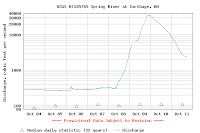
Carthage, MO. USGS readings indicated 309 cubic feet/minute at 1:15 pm, Thursday, October 8, and 4.11' water gage. Spring River crested (maximum gage and discharge) at 9:45 pm on Friday, October 9, and 35,200 cubic feet/minute and 17.71'water gage.

Waco, MO. USGS readings indicated 424 cubic feet/minute at 9:15 am, Thursday, October 8, and 2.46' water gage. Spring River crested (maximum gage and discharge) at 8:45 pm on Saturday, October 10, and 35,700 cubic feet/minute and 24.94' water gage.

Baxter Springs, KS. USGS readings indicated 969 cubic feet/minute at 8:15 am, Thursday, October 8, and 3.74' water gage. Spring River crested (maximum gage and discharge) at 4:45 pm on Saturday, October 10, and 60,900 cubic feet/minute and 21.18' water gage.

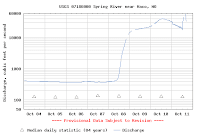
Quapaw, OK. USGS readings indicated 973 cubic feet/minute at 9:30 am, Thursday, October 8, and 6.53' water gage. Spring River crested (maximum gage and discharge) at 6:30 pm on Saturday, October 10, and 66,200 cubic feet/minute and 27.94' water gage.

Wednesday, September 30, 2009

Spring River Watershed Partnership - 5th Meeting

The Spring River Watershed Partnership committee met today to review the draft Spring River Watershed Management Plan for HUC #11070207140002. It should be finished in 30 days, after which, invitations to the original participants will be sent for their comments. The committee talked about setting up a survey for the original participants to help prioritize the most important issues. A copy of the Spring River Watershed Management Plan will be available online at the Jasper County Health Department and Environmental Task Force of Jasper and Newton Counties, websites.

Spring River Watershed Management Plan is to provide an initial assessment and a general strategic plan for the Spring River Watershed, and to focus on a 14-Digit HUC Code portion located in Central Jasper County near Carthage. The organizational format follows the nine elements recommended by the United States Environmental Protection Agency (EPA) Handbook for Developing Watershed Plans to Restore and Protect our Waters (2008). The Objective of this watershed plan is to reduce the number of bacterial levels (total coliform and E. coli) to below the whole body contact level for recreational waters.

Elements of Spring River Watershed Management Plan
1. Quantify Sources of Pollutant
2. Estimates of Pollutant Load Reductions
3. Non-Point Source (NPS) Management Measures
4. Estimate of Technical and Financial Assistance Needed
5. Information/Education Component
6. Schedule for Best Management Practices(BMP)Implementation
7. Description of Interim Milestones
8. Method Used o Determine Load Reduction
9. Water Quality Monitoring Program

In addition, there was preliminary discussion about sponsoring a Missouri Stream Team, Spring River cleanup for HUC #11070207140002.

Committee accepts proposed Spring River watershed plan w/ Spring River Watershed draft report, Joplin Globe, 10/01/2009

Draft copy Executive Summary Spring River Watershed Management Plan for HUC #11070207140002, Joplin Globe, 10/01/2009

Monday, September 21, 2009

USGA Water Gages in Spring River Watershed

Spring River at Quapaw, OK. USGS NO. 07188000 (Ottawa C0.)

Spring River at Baxter Springs, KS. USGS No. 07187600 (Cherokee Co.)

Spring River at Waco, MO. USGS No. 07186000 (Jasper Co)

Spring River at Carthage, MO. USGS No. 07185765 (Jasper Co.)

Spring River at La Russell, MO. USGS No. 07185700 (Jasper Co.)

North Fork Spring River at Purcell, MO. USGS No. 07185910 (Jasper Co.)

Shoal Creek at Joplin, MO. USGS No. 07187000 (Newton Co.)

Sunday, July 19, 2009

Esatern Shawnee Tribe Warns Swimmers of Bacteria

The Joplin Globe, reported 07/17/2009, that the Easter Shawnee Tribe (Ottawa Co, OK) was urging swimmers to stay out of the water, due to elevated bacteria levels. Oklahoma has set a standard of 235 colonies on E coli bacteria per 100 milliliter of river water. Samples taken last week from Lost Creek near the Missouri-Oklahoma state line, showed 2,419 colonies, while a sample from Spring River at the Highway 10 Bridge in Ottawa County, showed 866 colonies.

Wednesday, June 03, 2009

E. coli test Results - Spring River 2009

The Jasper County Health Department began testing for E. coli bacteria in Spring River in May 2007. They selected seven sites for weekly testing, including: Spring River at County Road 3 (referenced as SR1), Spring River at County Road 85 (SR2), Spring River at Kellogg Lake-Carthage (SR3), Spring River at Francis Street-Carthage (SR4), Spring River at Quaker Mill on County Lane 216 (SR5), and Spring River at Kafir and State Line (SR7). The following are test results for 2009.

The test results are shown as # of colonies of E. coli bacteria per 100 milliliters of river water. The data in Bold indicates that the # of colonies are in excess of the maximum recommended by the US EPA for bodily contact, which is 235 colonies of E. coli per 100 milliliter of water sampled. The Missouri Department of Natural Resources (MDNR) recommends a maximum of 126 E. coli colonies per 100 ml. as the limit for "recreational" swimming and whole body contact, annually between April 1 and October 31. The data is arranged by sampling site, with the latest data 'on top'.

Spring River at County Road 3 (SR1)

10/07/2009, 218.7
10/01/2009, 240.0
09/23/2009, 2419.6

09/17/2009, 248.1
09/03/2009, 167.4
08/26/2009, 298.7
08/19/2009, 135.4
08/12/2009, 2419.6
08/05/2009, 72.7
07/29/2009, 88.2
07/23/2009, 325.5
07/15/2009, 222.4
07/09/2009, 73.8
07/01/2009, 1203.3
06/24/2009, 83.9
06/18/2009, 2419.6
06/11/2009, 686.7

06/02/2009, 67.6
05/28/2009, 980.4

Spring River at County Road 85 (SR2)

10/07/2009, 344.8
10/01/2009, 185.0
09/23/2009, 2419.6
09/17/2009, 125.0
09/03/2009, 149.7
08/26/2009, 365.4
08/19/2009, 137.4
08/12/2009, 613.1
08/05/2009, 69.7
07/29/2009, 52.8
07/23/2009, 214.1
07/15/2009, 125.9
07/09/2009, 78.9
07/01/2009, 118.7
06/24/2009, 84.2
06/18/2009, 2419.6
06/11/2009, 1986.3

06/02/2009, 135.4
05/28/2009, 816.4

Spring River at Kellogg Lake-Carthage (SR3)

10/07/2009, 344.8
10/01/2009, 88.6
09/23/2009, 372.4
09/17/2009, 75.9
09/03/2009, 103.9
08/26/2009, 461.1
08/19/2009, 185.0
08/12/2009, 37.6
08/05/2009, 83.9
07/29/2009, 40.8
07/23/2009, 172.3
07/15/2009, 157.6
07/09/2009, 54.8
07/01/2009, 52.8
06/24/2009, 52.0
06/18/2009, 2419.6
06/11/2009, 372.5

06/02/2009, 86.2
05/28/2009, 1413.6

Spring River at Francis Street-Carthage (SR4)

10/07/2009, 517.2
10/01/2009, 152.9
09/23/2009, 533.5
09/17/2009, 119.8
09/03/2009, 1413.6
08/26/2009, 214.2
08/19/2009, 101.2
08/12/2009, 285.1
08/05/2009, 111.2
07/29/2009, 67.0
07/23/2009, 114.6
07/15/2009, 148.9
07/09/2009, 30.5
07/01/2009, 43.5
06/24/2009, 65.0
06/18/2009, 2419.6
06/11/2009, 322.3

06/02/2009, 95.9
05/28/2009, 1986.3

Spring River at Quaker Mill on County Lane 216 (SR5)

10/07/2009, 142.1
09/23/2009, 691.0
09/17/2009, 78.0
09/03/2009, 166.4
08/26/2009, 209.8
08/19/2009, 70.2
08/12/2009, 85.7
08/05/2009, 96.0
07/29/2009, 75.4
07/23/2009, 238.2
07/15/2009, 218.7
07/09/2009, 61.3
07/01/2009, 184.2
06/24/2009, 101.4
06/18/2009, 2419.6
06/11/2009, 2419.6

06/02/2009, 86.2
05/28/2009, 1553.1

Spring River at County Road 270 (SR6)

10/07/2009, 83.3
09/23/2009, 2419.6
09/17/2009, 93.4
09/03/2009, 44.8
08/26/2009, 204.6
08/19/2009, 91.0
08/12/2009, 114.5
08/05/2009, 57.6
07/29/2009, 81.3
07/23/2009, 2419.6
07/15/2009, 435.2
07/09/2009, 53.7
07/01/2009, 61.3
06/24/2009, 110.6
06/18/2009, 2419.6
06/11/2009, 1732.9

06/02/2009, 95.9
05/28/2009, 980.4

Spring River at Kafir and State Line (SR7)

10/07/2009, 90.9
09/23/2009, 2419.6
09/17/2009, 139.6
09/03/2009, 86.5
08/26/2009, 167.4
08/19/2009, 79.2
08/12/2009, 55.6
08/05/2009, 67.7
07/29/2009, 69.1
07/23/2009, 2419.6
07/15/2009, 206.4
07/09/2009, 56.3
07/01/2009, 64.4
06/24/2009, 74.9
06/18/2009, 960.6
06/11/2009, 2419.6

06/02/2009, 42.8
05/28/2009, 1413.6

For further information, contact:
Jasper County Health Department
105 Lincoln
Carthage, MO 64836
417/358-3111
417/358-0494 (fax)

Tuesday, June 02, 2009

Body Contact is NOT Recommended 5/28/2009

The Jasper County Health Department has posted the results of their 05/28/2009 water quality testing at seven locations on Spring River. Specifically, this is the number of Escherichia coli colonies per 100 milliliters of river water. The Environmental Protection Agency (EPA) has determined that swimming and body contact is NOT recommended when the sample exceeds 235 E. coli colonies per 100 ml. The Missouri Department of Natural Resources (MDNR) recommends a maximum of 126 E. coli colonies per 100 ml as the limit for "recreational" swimming and whole body contact, annually between April 1 and October 31.

The 05/28/2009 test results (E. coli colonies per 100 ml) and locations are listed below:

Swimming and body contact is NOT recommended at these sites.
980.4, Spring River at County Road 3
816.4, Spring River at County Road 85
1413.6, Spring River at Kellogg Lake
1986.3, Spring River at Francis Street
1553.1, Spring River at Quaker Mill, County Lane 216
980.4, Spring River at County Road 270
1413.6, Spring River at Kafir and State Line

For further information, contact:
Jasper County Health Department
105 Lincoln
Carthage, MO 64836
417/358-3111
417/358-0494 (fax)
moehra@lpha.dhss.mo.gov (e-mail)
877-879-9131 (toll free)
8:30 - 4:30 (hours)

Monday, April 27, 2009

50+ Attend Watershed Public Meeting

The Carthage Press reported , Friday, April 24, 2009, that over 50 people attended the Spring River Watershed Partnership Public Meeting, Thursday night. After an explanation of watershed planning by Dan Downing, University of Missouri Extension, and a review of watershed maps, those attending were divided into four smaller discussion groups. Each group discussed, then responded to four questions: (1) In general terms, how do you feel about the main stem of the Spring River and its watershed? Positive, neutral, negative? (2) What concerns do you have about the Spring River and its watershed? (3) What factors do you feel have the most influence on the watershed? and (4) What are some outstanding features about the river and its watershed? The responses will be included in the development of a Spring River Watershed Plan. Below are the consolidated responses from the four discussion groups:

In general terms how do you feel about the main stem of the Spring River and its watershed? Positive, neutral, negative?
• Don’t have a problem with it.
• Positive – 2 votes
• Negative – 5 votes
• Negative
• Much better now than 50 years ago
• Below Carthage, much better than 10 years ago.
• As a parent, will not let my child in the water.


What concerns do you have about the Spring River and its watershed?
• We make a living here. How will this impact us?
• Cow calf operations
• Regulations
• Personally ingesting _____?
• Bad press for agriculture
• What do e-Coli levels mean?
• Trash: Walnut Bottoms-Turkey Ford
• Raw poultry wastes
• Pesticides
• Human waste –sludge and industrial
• Food industry in Carthage bottoms
• Cattle
• Recreation
• Kellogg Lake
• What are we going to do to support agriculture because everyone wants distilled water flowing down the river?
• Want to be really certain where the problem comes from (if you don’t know the source, how are you going to fix it).
• Come up with solutions that aren’t a burden to any one entity.
• How are we going to measure any good we do-factor out outside sources such as headwater flow?
• Need to know more about the river and its watershed, i.e. sink holes, karst topography.
• Wildlife being poisoned
• Lagoons
• Educating people: urban and rural
• Prospect of excessive regulation (inc. determination of benchmarks)
• Excessive water usage
• Respect usage
• Opening Pandora’s Box (unintended consequences)

What factors do you feel have the most influence on the watershed?
• New Zealand dairies
• Soil conservation
• All soil disturbances
• Carthage Waterworks treatment
• ConAgra-waste (blood, guts, etc, knifed in)
• Heavy metals
• Dates on data
• Purcell Landfill
• Clean water: Is it used for drinking water?
• White Oak Creek influence
• How far does regulation reach?
• Urban run-off testing
• Trash: Walnut Bottoms-Turkey Ford – 5 votes
• Raw poultry wastes – 2 votes
• Leachate from septic systems
• Runoff from CAFOs
• Agriculture and residential chemical use
• Illegal trash dumps
• Industrial waste
• Be selective with what is detrimental to human and environment
• Psychology
• Population
• Erosion
• Enforcement of existing regulations
• Difference in core values
• Municipal water retention

What are some outstanding features about the river and its watershed?
• Recreation
• Living here
• People moving in
• Beautiful
• Wildlife
• Good access points
• Good fishing.
• Recreation, fishing and canoeing
• Supports agriculture
• Lots of springs on it (at least at one time)
• Many rivers provide drinking water for municipalities, Spring River does not. (Maybe not outstanding but is unique)
• How many species of wildlife/plants endangered by low quality water-should be checked out.
• Many concerned citizens
• Multi-use
• Supports a diverse wildlife
• Canoeing
• Scenic

Thursday, April 23, 2009

You're Invited to Watershed Public Meeting

The Carthage Press reported Sunday, April 19, 2009, that The Spring River Watershed group is hosting a public meeting on Thursday, April 23, 2009, beginning at 7:00 pm, at Carthage High School Technical Center (Agricultural Department), 609 River Street, Carthage, MO. The purpose of the meeting is to collect input on ways of enhancing the water quality on Spring River. The input session is open to Jasper County residents located on or near the Spring River as well as Carthage residents.

Sunday, March 22, 2009

Spring River Watershed Partnership - 4th Meeting

The Carthage Press reported on the Wednesday, March 17. 2008 meeting, "Public input meeting tabbed to discuss dirty Spring River", which included identifying the specific section of Spring River to focus on, approving an organizational logo, starting the process of drafting the Watershed Plan and then setting a date for a public input meeting, scheduled for Thursday April 23 @7:00 pm (location to be announced).

Sunday, December 14, 2008

Spring River Watershed Partnership - 2nd Meeting

A group of twelve met Friday, Dec. 12, 2008 in carthage, MO. for the purpose of continuing the conversation of establishing a (Jasper County, MO) Spring River Watershed organization. The Carthage Press reported (12/14/2008) Plan of Attack Revealed, on the priortization of desired outcomes for the group, Spring River Watershed Partnership. The MISSION: "Protect, conserve and restore water quality and water quantity though scientific and educational programs for all who receive the benefits of Spring River Watershed". The group agreed to initially focus on the Spring River (elevated bacteria levels) and North Fork of Spring River (excessive sediment levels). The next step is to identify all groups that have done or are doing research in these taget areas. Then the group will begin assimilating data regarding the problems, in order to develop plans for management and solutions.

Sunday, December 07, 2008

White Oak Creek Erosion Project

The Joplin Globe reported that the Jasper County (MO) Commissioners agreed to seek state approval for a project that would stabilize the stream bank at a bridge over White Oak Creek. The article, Panel Moves to Save Soil, reports that "the county is working on four potential projects with representatives of the Natural Resources Conservation Service, a division of the U.S. Department of Agriculture. A report on the problem will be submitted to the state, which allocates federal funds for the work, said Derek Ball of the NRCS office in Carthage. 'There is severe erosion both upstream and downstream of the bridge where the bank is giving way because of the 100-year flood events we’ve had in the last several years,' Ball said. The county also is looking at potential projects on County Road 118 near Morrow Mill, on Pine Road near County Road 160 and on County Road 110 south of Blackberry Road. The project near Morrow Mill is the largest of the four and also will involve the U.S. Army Corps of Engineers."

Shoal Creek Watershed Improvement Group

The Joplin Globe, article in today's paper, Cash Flow Into Creek, describes the award of $224,000 from the Missouri Department of Natural Resources (MDNR) to the Shoal Creek Watershed Improvement Group. Drew Holt, who works with the watershed group, said the bacterial loading is coming from three sources. “DNA tracking during low flows and higher flows showed three primary sources. It’s one-third human, one-third poultry and one-third cattle,” he said. Property owners along the creek and its tributaries will be eligible for assistance, along with homeowners living within a half-mile of environmentally-sensitive areas, such as losing streams, sinkholes and springs, the MDNR said. The grant was funneled from the federal government to Missouri’s Water Protection Program through a Clean Water Act appropriation.

Information about the project is available by contacting MDNR’s Water Protection Program at (573) 751-1300 or Drew Holt with the Shoal Creek Watershed Improvement Group at (417) 838-1939.

Friday, November 14, 2008

Impaired Streams, Section 303 (d) Federal Clean Water Act

The Joplin Globe, Friday, November 14, 2008, provided an update of streams in southwest Missouri (including Spring River) that are on the Environmental Protection Agency's list of Impaired Streams. Included is a link to the EPA's complete list of impaired streams in Missouri. The EPA’s list of impaired streams by county in Southwest Missouri is as follows:

Barry: 4 miles of Shoal Creek were added because of low dissolved oxygen.
Barton: 51.5 miles of the North Fork of Spring River remain on the list because of ammonia.
Jasper: 7.5 miles of Blackberry Creek were added because of sulfate and chloride; 7 miles of Turkey Creek remain on the list because of cadmium, but bacteria also has been identified as a pollutant; 26 miles of Center Creek remain on the list because of cadmium and lead; 58.5 miles of the Spring River remain on the list because of bacteria (part of the river is in Lawrence County).
Lawrence: 9 miles of Clear Creek were added because of bacteria, and 6 miles of the creek remain on the list because of low dissolved oxygen and nutrients (portions of the creek are in Barry and Newton counties); 4.5 miles of Douger Branch remain on the list because of cadmium and lead.
McDonald: A small stretch of Cave Spring Branch, which receives wastewater from the Simmons poultry plant near Southwest City, remains on the list; 26 miles of Indian Creek remain on the list because of bacteria (part of the creek is in Newton County).
Newton: 4 miles of Capp’s Creek remain on the list because of bacteria; 4.5 miles of Hickory Creek remain on the list because of bacteria; 8.5 miles of Lost Creek remain on the list because of bacteria.
Vernon: 15 miles of Clear Creek were added to the list because of low dissolved oxygen; 17 miles of Little Drywood Creek were added because of low dissolved oxygen; 16 miles of the Little Osage River were not delisted because of low dissolved oxygen; 49 miles of the Marmaton River were not delisted because of low dissolved oxygen; 5.5 miles of the West Fork of Drywood Creek were added because of low dissolved oxygen.

Tuesday, October 28, 2008

Spring River Watershed Partnership

A group of 15 concerned citizens met in Carthage (Jasper Co.) MO, October 14, 2008, for what was referred to as an "organizational meeting of the Spring River Watershed Partnership". Those individuals making a presentation to the group included Jasper County Commissioner Jim Honey; Environmental Task Force of Jasper and Newton Counties, President, Bob Nichols; Tony Moehr, Jasper County Health Department; Dan Downing, Water Quality Associate, Water Quality Program, University of Missouri Extension; Carl Hayes, Spring River Watershed Restoration and Protection Strategy (Kansas); and Drew Holt, Elk River Watershed Group.

Commissioner Honey explained that the purpose of the group was to form a committee that would undertake to develop a watershed plan and then carry out the implementation of the plan. The Spring River Watershed Partnership will operate within the Environmental Task Force of Jasper and Newton Counties organizational structure. The next planning meeting will be in December 2008.

Monday, October 20, 2008

Body Contact NOT Reccomended 10/17/2008

The Jasper County Health Department has posted the results of their 10/17/2008 water quality testing at seven locations on Spring River. Specifically, this is the number of Escherichia coli colonies per 100 milliliters of river water. The Environmental Protection Agency (EPA) has determined that swimming and body contact is NOT recommended when the sample exceeds 235 E. coli colonies per 100 ml.

The 10/17/2008 test results (E. coli colonies per 100 ml) and locations are listed below:

Swimming and body contact is NOT recommended at these sites.
313.0, Spring River at County Road 3
298.7, Spring River at County Road 85
365.4, Spring River at Kellogg Lake
365.4, Spring River at Francis Street
260.3, Spring River at County Road 270

The following 2 locations were reported below the 235 limit.
77.1, Spring River at Quaker Mill, County Lane 216
95.8, Spring River at Kafir and State Line

For further information, contact:
Jasper County Health Department
105 Lincoln
Carthage, MO 64836
417/358-3111
417/358-0494 (fax)
moehra@lpha.dhss.mo.gov (e-mail)
877-879-9131 (toll free)
8:30 - 4:30 (hours)

Thursday, September 25, 2008

E. coli Test results, 10/09/2008 below 235 limit

The Jasper County Health Department has posted the results of their 10/09/2008 water quality testing at seven locations on Spring River. Specifically, this is the number of Escherichia coli colonies per 100 milliliters of river water. The Environmental Protection Agency (EPA) has determined that swimming and body contact is NOT recommended when the sample exceeds 235 E. coli colonies per 100 ml.
The sampling results for Spring River today, indicate that all seven of their test sites were below the EPA recommended limit of 235 E. coli colonies per 100 milliliters of river water.
NOTE: This will be the last scheduled water quality testing on Spring River until Spring 2009.

For further information, contact:
Jasper County Health Department
105 Lincoln
Carthage, MO 64836
417/358-3111
417/358-0494 (fax)
moehra@lpha.dhss.mo.gov (e-mail)
877-879-9131 (toll free)
8:30 - 4:30 (hours)

Friday, September 19, 2008

Spring River Watershed Restoration & Protection Strategy Group

The Joplin Globe, Friday, September 19, 2008, reported that The Spring River Watershed Restoration and Protection Strategy (WRAPS) group recently selected as a demonstration project, creating a wetland in Schermerhorn Park, which also is the location of the Southeast Kansas Nature Center. Shoal Creek flows into Spring River just west of Schermerhorn Park. Crystal Eisele, watershed coordinator with Southeast Kansas Resource Conservation and Development, and Carl Hayes, chairman of the Spring River Watershed Restoration and Protection Strategy group, are involved in the project.

Kansas group, federal agency work to restore Spring River w/ link to Cherokee County Restoration Plan and Environmental Assessment The Joplin Globe, August 13, 2008

Body Contact NOT Recommended 09/18/2008

The Jasper County Health Department has posted the results of their 09/18/2008 water quality testing at seven locations on Spring River. Specifically, this is the number of Escherichia coli colonies per 100 milliliters of river water. The Environmental Protection Agency (EPA) has determined that swimming and body contact is NOT recommended when the sample exceeds 235 E. coli colonies per 100 ml.

The 09/18/2008 test results (E. coli colonies per 100 ml) and locations are listed below:

Swimming and body contact is NOT recommended at these sites.
920.8, Spring River at County Road 3
517.2, Spring River at County Road 85
613.1, Spring River at Kellogg Lake
727.0, Spring River at Francis Street
308.8, Spring River at Quaker Mill, County Lane 216
249.5, Spring River at Kafir and State Line

For further information, contact:
Jasper County Health Department
105 Lincoln
Carthage, MO 64836
417/358-3111
417/358-0494 (fax)
moehra@lpha.dhss.mo.gov (e-mail)
877-879-9131 (toll free)
8:30 - 4:30 (hours)

Wednesday, July 09, 2008

E. coli test Results - 09/11/2008 Below 235 Limit

The Jasper County Health Department has posted the results of their 09/11/2008 water quality testing at seven locations on Spring River. Specifically, this is the number of Escherichia coli colonies per 100 milliliters of river water. The Environmental Protection Agency (EPA) has determined that swimming and body contact is NOT recommended when the sample exceeds 235 E. coli colonies per 100 ml.
The sampling results for Spring River today, indicate that all seven of their test sites were below the EPA recommended limit of 235 E. coli colonies per 100 milliliters of river water.

For further information, contact:
Jasper County Health Department
105 Lincoln
Carthage, MO 64836
417/358-3111
417/358-0494 (fax)
moehra@lpha.dhss.mo.gov (e-mail)
877-879-9131 (toll free)
8:30 - 4:30 (hours)

Wednesday, July 02, 2008

Body Contact is NOT Recommended 7/2/2008

The Jasper County Health Department has posted the results of their 07/02/2008 water quality testing at seven locations on Spring River. Specifically, this is the number of Escherichia coli colonies per 100 milliliters of river water. The Environmental Protection Agency (EPA) has determined that swimming and body contact is NOT recommended when the sample exceeds 235 E. coli colonies per 100 ml.

The 07/02/2008 test results (E. coli colonies per 100 ml) and locations are listed below:

Swimming and body contact is NOT recommended at these sites.
365.4, Spring River at County Road 3
579.4, Spring River at County Road 85
387.3, Spring River at Kellogg Lake
435.2, Spring River at Francis Street
613.1, Spring River at Quaker Mill, County Lane 216
456.5, Spring River at County Road 270
272.3, Spring River at Kafir and State Line


For further information, contact:
Jasper County Health Department
105 Lincoln
Carthage, MO 64836
417/358-3111
417/358-0494 (fax)
moehra@lpha.dhss.mo.gov (e-mail)
877-879-9131 (toll free)
8:30 - 4:30 (hours)

Thursday, May 15, 2008

E. coli test Results - Spring River 2008 (Jasper County, MO)

The Jasper County Health Department began testing for E. coli bacteria in Spring River in May 2007. They selected seven sites for weekly testing, including: Spring River at County Road 3 (referenced as SR1), Spring River at County Road 85 (SR2), Spring River at Kellogg Lake-Carthage (SR3), Spring River at Francis Street-Carthage (SR4), Spring River at Quaker Mill on County Lane 216 (SR5), and Spring River at Kafir and State Line (SR7). The following are test results for 2008.

The test results are shown as # of colonies of E. coli bacteria per 100 milliliters of river water. The data in Bold indicates that the # of colonies are in excess of the maximum recommended by the US EPA for bodily contact, which is 235 colonies of E. coli per 100 milliliter of water sampled. The data is arranged by sampling site, with the latest data 'on top'.

Spring River at County Road 3 (SR1)
10/17/2008, 313.0
10/09/2008, 95.9
10/01/2008, 104.3
09/24/2008, 118.7
09/18/2008, 920.8
09/11/2008, 96.0
08/27/2008, 59.1
08/20/2008, 66.3
08/13/2008, 74.8
08/07/2008, 76.8
07/29/2008, 104.3
07/23/2008, 52
07/16/2008, 67.7
07/09/2008, 70.8
07/02/2008, 365.4
06/25/2008, 1299.7
06/19/2008, 344.8
06/11/2008, 791.5
06/04/2008, 1119.9
05/28/2008, 501.2
05/21/2008, 83.6
05/13/2008, 435.2

Spring River at County Road 85 (SR2)
10/17/2008, 298.7
10/09/2008, 120.1
10/01/2008, 86.2
09/24/2008, 238.2
09/18/2008, 517.2
09/11/2008, 178.9
08/27/2008, 95.9
08/20/2008, 58.1
08/13/2008, 55.6
08/07/2008, 64.4
07/29/2008, 228.2
07/23/2008, 62.2
07/16/2008, 58.3
07/09/2008, 118.7
07/02/2008, 579.4
06/25/2008, 1119.9
06/19/2008, 275.5
06/11/2008, 1986.3
06/04/2008, 980.4
05/28/2008, 1299.7
05/21/2008, 91
05/13/2008, 410.6

Spring River at Kellogg Lake-Carthage (SR3)
10/17/2008, 365.4
10/09/2008, 95.9
10/02/2008, 88.6
09/24/2008, 103.9
09/18/2008, 613.1
09/11/2008, 156.5
08/27/2008, 95.9
08/20/2008, 74.3
08/13/2008, 63.8
08/07/2008, 98.8
07/29/2008, 248.1
07/24/2008, 44.3
07/16/2008, 77.6
07/09/2008, 70.3
07/02/2008, 387.3
06/25/2008, 1732.9
06/19/2008, 178.9
06/11/2008, 1553.1
06/04/2008, 1413.6
05/28/2008, 1413.6
05/21/2008, 93.4
05/13/2008, 360.9

Spring River at Francis Street-Carthage (SR4)
10/17/2008, 356.4
10/09/2008, 142.1
10/02/2008, 72.7
09/24/2008, 117.8
09/18/2008, 727.0
09/11/2008, 125.9
08/27/2008, 123.6
08/20/2008, 60.9
08/13/2008, 116.9
08/07/2008, 78.0
07/29/2008, 235.9
07/24/2008, 45.7
07/16/2008, 93.3
07/09/2008, 80.1
07/02/2008, 435.2
06/25/2008, 1413.6
06/19/2008, 156.5
06/11/2008, 2419.6+
06/04/2008, 920.8
05/28/2008, 1986.3
05/21/2008, 79.4
05/13/2008, 387.3

Spring River at Quaker Mill on County Lane 216 (SR5)
10/17/2008, 77.1
10/09/2008, 88.4
10/01/2008, 51.2
09/24/2008, 90.9
09/18/2008, 308.8
09/11/2008, 137.6
08/27/2008, 68.3
08/20/2008, 52.8
08/13/2008, 59.1
08/07/2008, 73.8
07/29/2008, 165.8
07/24/2008, 59.8
07/16/2008, 121.1
07/09/2008, 69.7
07/02/2008, 613.1
06/25/2008, 1732.9
06/19/2008, 210.5
06/11/2008, 499.6
06/04/2008, 1413.6
05/28/2008, 1203.3
05/22/2008, 10.7
05/13/2008, 222.4

Spring River at County Road 270 (SR6)
10/17/2008, 260.3
10/09/2008, 58.3
10/01/2008, 46.5
09/24/2008, 74.8
09/18/2008, 196.8
09/11/2008, 172.3
08/27/2008, 65.0
08/20/2008, 27.5
08/13/2008, 96.0
08/07/2008, 87.8
07/29/2008, No sample, broken bottle
07/24/2008, 31.8
07/16/2008, 275.5
07/09/2008, 83.6
07/02/2008, 456.5
06/25/2008, 1553.1
06/19/2008, 157.6
06/11/2008, 1732.9
06/04/2008, 727.0
05/28/2008, 2419.6+
05/22/2008, 48
05/13/2008, 304.4

Spring River at Kafir and State Line (SR7)
10/17/2008, 95.8
10/09/2008, 52.0
10/01/2008, 36.8
09/24/2008, 56.5
09/18/2008, 249.5
09/11/2008, 125.9
08/27/2008, 38.4
08/20/2008, 18.3
08/13/2008, 40.8
08/07/2008, 35.0
07/29/2008, 344.8
07/24/2998, 40.8
07/16/2008, 191.8
07/09/2008, 53.7
07/02/2008, 272.3
06/25/2008, 1299.7
06/19/2008, 325.5
06/11/2008, 920.8
06/04/2008, 648.8
05/28/2008, 2419.6+
05/22/2008, 30.5
05/13/2008, 579.4

For further information, contact:
Jasper County Health Department
105 Lincoln
Carthage, MO 64836
417/358-3111
417/358-0494 (fax)

Thursday, March 20, 2008

Oklahoma Attorney General Seeks to Halt Litter Application in Illinois River Watershed. Will Spring River Watershed be next?

The Oklahoma Attorney General, W. A. Drew Edmondson, has filed a suit to halt poultry waste disposal in the Illinois River Watershed. Citing an “imminent and substantial endangerment” to public health, the State of Oklahoma today asked a federal judge to prohibit any further land application of poultry waste in the Illinois River Watershed (IRW). Showing a “direct path from the place of poultry waste disposal to the locations...where contamination is found,” the state presented evidence that the poultry companies’ reckless waste dumping methods are contributing to high levels of bacteria in the waters of the state. “We can show that fecal bacteria in poultry waste is reaching the surface water and groundwater,” Edmondson said. “Scientists found areas where the bacterial counts in runoff water from poultry waste disposal fields were similar to those found in raw, untreated human sewage. These bacteria can cause a myriad of gastrointestinal illnesses and infections through ingestion and skin contact. We need the court to stop the dumping of waste to protect public health and the safety of the state’s water resources.”

News Release, State Seeks to Halt Litter Application

Copy of, State of Oklahoma's Motion for Preliminary Injunction

How long will it be before he files a similar suit against polluters in the Spring River Watershed?

Sunday, January 13, 2008

Recent Headlines in Spring River Watershed

More and more concern is being focused on the Spring River watershed in southwest Missouri, southeast Kansas and northeast Oklahoma. Below are recent newspaper headlines and publications decribing efforts to identify, then organize groups to begin developing strategies to protect and preserve the natural resource we have.

Officials Explore Watershed Committee for Spring River, The Carthage Press reported, 1/4/2008, that Jasper County Eastern District Commissioner Jim Honey, Jasper County Health Department Director Tony Moehr and Bob Nichols, Webb City resident who has spearheaded the creation of such groups as the Tri-State Water Resources Coalition, all said they are exploring ways to do something to improve the quality of the water in the Spring River. The three agreed to meet with officials with the University of Missouri Extension Service who are experienced in setting up watershed groups and applying for grants, then set up an exploratory committee to decide how much of the Spring River watershed they wanted to tackle and what kind of group to form.

Watershed Group Reaching out to Landowners, The Joplin Globe reported 10/26/2007 that support of property owners will be the key element in any plans shaped for the lower Shoal Creek watershed. The Lower Shoal Creek Watershed Committee has sent out the first round of surveys to property owners along the stream to gauge their “knowledge and perception of water quality issues,” said Craig Jones, a planner for the Harry S. Truman Coordinating Council, which is advising the group. A second round of surveys is planned for later this year.

Soil and Water District Awaits Word on North Fork Grant, and Conservation Group Seeks Funds, The Joplin Globe, 11/24/2007 reported that Jasper County Soil and Water Conservation District, is seeking about $1.5 million in federal funding to improve water quality in the North Fork of Spring River; the goal is to lower sediment getting into the stream by up to 35 percent by implementing a variety of streamside and watershed management projects. Money is being sought from the Missouri Department of Natural Resources. In addition to this grant, the project could be eligible for $1.9 million in matching funds (including in-kind services) and $37,326 in other federal money. The total project cost would be around $3.4 million.

The previous article, 10/7/2007, reported that the application relates to a 251,360-acre watershed, most of which is in Barton and Jasper counties. Lawrence County residents who own land in the 4,000 acres in that county that are part of the North Fork watershed also may participate. Work to improve water quality also could help reduce flooding along the stream. A potential goal of the grant is to develop 20 controlled grazing systems to keep livestock out of streams. Such systems would fence off streams and take water to cattle.

Compiled Testing Results Raise Stream Worries, The Joplin Globe, 10/26/2007 reported that parts of several streams in Jasper and Newton counties were classified as “impaired” earlier this year, but two residents concerned about water quality say more should be added to the federal listing. Wayne Christian, of Carthage, and Dewayne Miller, of Goodman, say bacteria levels are high on streams throughout the region, based on tests done by health departments and volunteer stream teams last summer. The two have compiled results of tests done by health departments in Jasper, Newton and Lawrence counties in Missouri, the Cherokee County Health Department in Kansas and the Eastern Shawnee Tribe of Oklahoma. The information will be shared with the participating agencies, and submitted to the Missouri Department of Natural Resources, to support an argument that more streams should be classified as impaired.

Shoal Creek Conservation Area, This is a link to a Missouri Department of Conservation fact sheet on the Shoal Creek Conservation Opportunity Area (COA). It describes the strategies, priority research and inventory needs, a list of present and prospective partners and conservation challenges for the COA.

New Group Set to Tackle Water Issues, The Joplin Globe, 11/12/2007 reported that a new water resources group has formed to coordinate the activities of watershed groups in the Four-State Area. The organizers of the Multi-Basin Regional Water Council met for their first summit at the Bentonville (Ark.) Public Library to talk about water issues in the region. After a three-hour conference, the representatives of the 25 or so water groups attending decided to form the council. Among the groups attending the conference were the Elk River Watershed Improvement Association in McDonald County, the Tri-State Water Resource Coalition, the Grand Lake (Okla.) Watershed Foundation and the Beaver (Ark.) Water District. Bill Millagers, a Rogers, Ark., resident who organized the conference, said the makeup of the council reflects the fact that both surface water and groundwater flow across state lines. “All of these groups are interlocked,” he said. “Because of that, this council could make a difference in discussions of policy, infrastructure investment and the protection of watersheds.”

Group Establishes Top Environmental Priorities for Spring River, Clean drinking water, and healthy and abundant aquatic life were among the top best-case scenarios for the future of the Spring River watershed determined Thursday by members of The Spring River Watershed Restoration and Protection Strategy Group. Safe water recreation was a third priority. Among the worst-case scenarios: a river polluted beyond repair, and contamination and disappearance of aquatic life. The group at its fourth meeting also heard about watershed protection groups in Missouri and Oklahoma. The group is supported by See-Kan Resource Conservation and Development and Pittsburg State University. The Joplin Globe, 8/9/2007.

Task Force Updated on Waste Cleanup, The Joplin Globe quotes, 7/24/2007, Mark Doolan, project manager with the Environmental Protection Agency, at a meeting of the Environmental Task Force of Jasper and Newton Counties, regarding an update from on water-quality testing in Spring River. Water samples are being tested for heavy metals, Doolan said, and the results should be available in the next few weeks. Once that is completed, tests for toxicity will begin. The tests will measure chemical compounds such as phosphates, pesticides, nitrates and other substances.

Flooding Flushes Bacteria into Jasper County Streams w/ Water Quality Testing Data for Spring River in Jasper County, The Joplin Globe, reported 6/24/2007 Bacteria levels in Spring River at Kellogg Lake exceeded federal standards more than tenfold after the rainstorms more than a week ago. That’s according to data compiled by the Jasper County Health Department showing the results of weekly testing of streams throughout the county since late May. The Environmental Protection Agency recommends against swimming in water with E. coli levels of 235 colonies per 100 milliliters of water. The sample taken June 13 at Kellogg Lake tested at 2,419.6 colonies. The eight samples taken that day from Center Creek, Spring River and Turkey Creek tested above federal levels, all but one at least seven times over the standard.

Southwest Missouri and Northwest Arkansas Watershed Groups, This is link to a Natural Resources Conservation Service publication, listing all of the watershed initiatives in Southwest Missouri and Northwest Arkansas, including contact and historical information for each.

Friday, August 10, 2007

Watershed Restoration & Protection Strategy Group

Roger McKinney reports in The Joplin Globe, Flow of Ideas, Group Establishes Top Environmental Priorities for Spring River, the progress that the Spring River Watershed Restoration & Protection Strategy Group (SRWR&PSG) made at its meeting, Thursday, August 9, Baxter Springs, KS. The group, supported by See-Kan RC&D along with Pittsburg State University, identified: clean drinking water as the #1 priority, a healthy and abundant aquatic life as #2, and safe water for recreation as the #3 priority.

Groups attending or represented at the Strategy meeting were:

  • Harry S. Truman Coordinating Council of Southwest Missouri - Craig Jones
  • Elk River Watershed Improvement Association
  • Southwest Missouri Water Quality Improvement Project
  • Upper Shoal Creek Watershed Improvement Group-Barry County
  • Shoal Creek Watershed Partnership
  • Grand Lake of the Cherokees Watershed Foundation - Carl Metcalf & John Gillette
  • Pittsburg State University - Shirley Drew, Jim Triplett
  • Cherokee County Health Department - Carl Hayes
This was the fourth meeting of the SRWR&PSG. Carl Metcalf is quoted as saying that the group strives to be cooperative rather than confrontational, and having representatives from Kansas, Missouri and Oklahoma is critical. Previously, the group had targeted Spring River issues, including (1) water quality and the contamination from heavy metals and fecal bacteria; (2) water quality and the depletion of the area aquifer by large consumers in Missouri; and (3) the stability of the river banks.

Septic tanks continue to be a contributing cause of water contamination, according to a presentation by Craig Jones. He said that 70% of septic systems in Missouri are considered to be failing. Jim Triplett added that the soil type in southeast Kansas is mostly clay, which is not good for septic tanks.

The groups next meeting will be Thursday, Septemeber 6, 2007.

Wednesday, August 08, 2007

E. coli test Results - Spring River (Jasper County)

The Jasper County Health Department began testing for E. coli bacteria in Spring River on May 24, 2007. They selected seven sites for weekly testing, including: Spring River at County Road 3 (referenced as SR1), Spring River at County Road 85 (SR2), Spring River at Kellogg Lake-Carthage (SR3), Spring River at Francis Street-Carthage (SR4), Spring River at Quaker Mill on County Lane 216 (SR5), and Spring River at Kafir and State Line (SR7).

The test results are shown as # of colonies of E. coli bacteria per 100 milliliters of river water. The data in Bold indicates that the # of colonies are in excess of the maximum recommended by the US EPA for bodily contact, which is 235 colonies of E. coli per 100 milliliter of water sampled. The data is arranged by sampling site, with the latest data 'on top'.

Spring River at County Road 3 (SR1)
10/19/2007, 77.6
09/25/2007, 83.9
09/19/2007, 131.4
09/05/2007, 387.3
09/05/2007, 325.5
08/29/2007, 158.5
08/21/2007, 2,419.6+
08/14/2007, 75.9
08/07/2007, 64.3
07/31/2007, 82.3
07/24/2007, 101.4
07/17/2007, 172.3
07/10/2007, 1986.3
07/02/2007, 1046.2
06/26/2007, 816.4
06/19/2007, 290.9
06/13/2007, 870.4
06/05/2007, 517.2
05/30/2007, 107.1
05/24/2007, 114.5

Spring River at County Road 85 (SR2)
10/19/2007, 135.4
09/25/2007, 142.1
09/19/2007, 172.3
09/05/2007, 920.8
09/05/2007, 248.1
08/29/2007, 129.6
08/21/2007, 1,119.9
08/14/2007, 35.9
08/07/2007, 70.3
07/31/2007, 91
07/24/2007, 161.6
07/17/2007, 95.9
07/10/2007, 228.2
07/02/2007, 920.8
06/26/2007, 547.5
06/19/2007, 128.1
06/13/2007, 1732.9
06/05/2007, 613.1
05/30/2007, 112.6
05/24/2007, 52.9

Spring River at Kellogg Lake-Carthage (SR3)
10/18/2007, 461.1
09/25/2007, 125
09/19/2007, 113
09/05/2007, 517.2
09/05/2007, 410.6
08/29/2007, 81.6
08/21/2007, 2,419.6+
08/14/2007, 46.4
08/07/2007, 41.7
07/31/2007, 88.2
07/24/2007, 72.3
07/17/2007, 95.9
07/10/2007, 116
07/02/2007, 1299.7
06/26/2007, 225.4
06/19/2007, 161.6
06/13/2007, 2419.6
06/05/2007, 365.4
05/30/2007, 148.3
05/24/2007, 18.7

Spring River at Francis Street-Carthage (SR4)
10/19/2007, 248.1
09/25/2007, 93.4
09/19/2007, 100.8
09/05/2007, 517.2
09/05/2007, 435.2
08/29/2007, 83.9
08/21/2007, 2,419.6+
08/14/2007, 31.2
08/07/2007, 69.7
07/31/2007, 88.6
07/24/2007, 95.9
07/17/2007, 77.6
07/10/2007, 235.9
07/02/2007, 1203.3
06/26/2007, 328.2
06/19/2007, 172.3
06/13/2007, 1986.3
06/05/2007, 290.9
05/30/2007, 131.4
05/24/2007, 45

Spring River at Quaker Mill on County Lane 216 (SR5)
10/19/2007, 93.3
09/25/2007, 74.9
09/19/2007, 101
09/05/2007, 613.1
09/05/2007, 172.3
08/28/2007, 151.5
08/21/2007, 2,419.6+
08/14/2007, 81.3
08/07/2007, 91
07/31/2007, 116.9
07/24/2007, 57.3
07/17/2007, 93.3
07/10/2007, 816.4
07/02/2007, 980.4
06/26/2007, 101.7
06/19/2007, 240
06/14/2007, 156.5
06/05/2007, 344.8
05/30/2007, 135.4
05/24/2007, 127.4

Spring River at County Road 270 (SR6)
10/19/2007, 113.7
09/25/2007, 53.8
09/19/2007, 107.1
09/05/2007, 344.8
09/05/2007, 122.3
08/28/2007, 285.1
08/21/2007, 2,419.6+
08/14/2007, 71.2
08/07/2007, 75.9
07/31/2007, 167
07/24/2007, 125
07/17/2007, 72.7
07/10/2007, 167.4
07/02/2007, 686.7
06/26/2007, 648.8
06/19/2007, 191.8
06/14/2007, 160.7
06/05/2007, 344.8
05/30/2007, 325.5
05/24/2007, 67

Spring River at Kafir and State Line (SR7)
10/19/2007, 161.6
09/25/2007, 59.8
09/19/2007, 75.4
09/05/2007, 225.4
09/05/2007, 172.5
08/28/2007, 158.5
08/21/2007, 2,419.6+
08/14/2007, 40.5
08/07/2007, 39.1
07/31/2007, 135.4
07/24/2007, 86
07/17/2007, 78.9
07/10/2007, 156.5
07/02/2007, 648.8
06/26/2007, 95.9
06/19/2007, 178
06/13/2007, 151.5
06/05/2007, 261.3
05/30/2007, 209.8
05/24/2007, 69.7

For further information, contact:
Jasper County Health Department
105 Lincoln
Carthage, MO 64836
417/358-3111
417/358-0494 (fax)
moehra@lpha.dhss.mo.gov (e-mail)
877-879-9131 (toll free)
8:30 - 4:30 (hours)

Sunday, August 05, 2007

Spring River Watershed Stakeholder Leadership Team

SEE-Kan RC&D (US Department of Agriculture, Resource Conservation and Development) has announced a Spring River Watershed Stakeholder Leadership Team meeting for Thursday, August 9, 2007, 4-6:30 pm, at the Baxter Springs Community Center, 1101 East Avenue. The Joplin Globe reported (Sunday, August 5, 2007) that See-Kan RC&D, and Pittsburg State University are facilitating the meeting, to help develop a team of stakeholders who will provide leadership and direction for restoring the watershed. Craig Jones with the Harry S. Truman Coordinating Council will provide the group with information regarding water protection strategies in Missouri. For more information, call 620-431-6180.